
Recovery
The primary factor to increasing performance on the bike is training and recovery. Here are some of the fundamentals to optimising your recovery so that you can train day after day, week after week. There are many tools and fads out there, but the most effective thing you can do is sleep and to get your nutrition dialled in. Here we are going to look at how to refine your recovery process to get the best out of your training and racing
Recovery essentials
Sleep
-
Sleep is indeed the biggest performance enhancer we have avaliable. Aim for consistent bed/wake times. Having a stable routine can be the biggest regulator of training and recovery. Our body has its own circadian rhythm, which helps regulate hormone, metabolism and tissue repair. Start disrupting the timing and all of these can become out of sync and less effective.
-
Aim for 7.5-9h sleep a night. Obviously the latter is more preferable, but thats not often realistic if work hours are long and/or parental duties for example. less the 7h starts to impact that recovery process.
Nutrition
-
How you arrive at a session, how you fuel during and how you replenish post training can make a big difference on the quality and consistency of training and the adaptive response, especially if training frequency is high or intense.
-
The key factors to consider for recovery from a nutrition perspective is – refuel, repair and replenish.
Deload weeks
-
Its crucial to allow periods where there are reduced workload from training. The principle form of adapting to training is to progressively overload/stress the body so that it promotes an adaptive response, and then allow the body to adapt. Basic principles of constructing a training program is to reduce volume every 3–4 weeks (~30% of workload) consolidate adaptations. (this is especially important as intensity increases).
Active recovery / Mobility / Soft Tissue Massage
-
If you’re heavy-legged after a big training day or block, a 30–60 min easy spin + mobility may be the best for promoting increase circulation and blood flow to the muscles and remove any metabolic waste byproducts.
-
Use foam rolling/massage to help mobilise key muscle groups and counteract the frequent position we adopt on the bike.
How does nutrition play a role in recovery
Refuel (carbohydrates) to restore glycogen, expecially if we have another workout in the next 12-24h
Repair (protein) to rebuild muscle tissue and aerobic energy system organelles (e.g mitochondria)
Rehydrate (fluids + electrolytes) to restore fluid balance, especially in warmer environments.
Pre Training/Racing (+24h)
If the training session is a key, high intensity interval session or a main event/race then the following principles are important.
- For longer high intensity events/training, the status that we arrive at the session is key. Contrary to old traditions of “making up” for kcals after, what status we arrive in is going to play the biggest role to execution of that session or outcome of a race. Consider carb-loading principles: 8–12 g/kg carbs in the 24–36h pre-event (races >90 min).
Arrive topped up and hydrated. 6-8ml/kg.BW in the 2h prior is recommended as a guide although it may need to be adjusted to individual and environmental needs.
During Training/Racing (basic rules)
Less than 1 hour: usually no fuelling needed unless
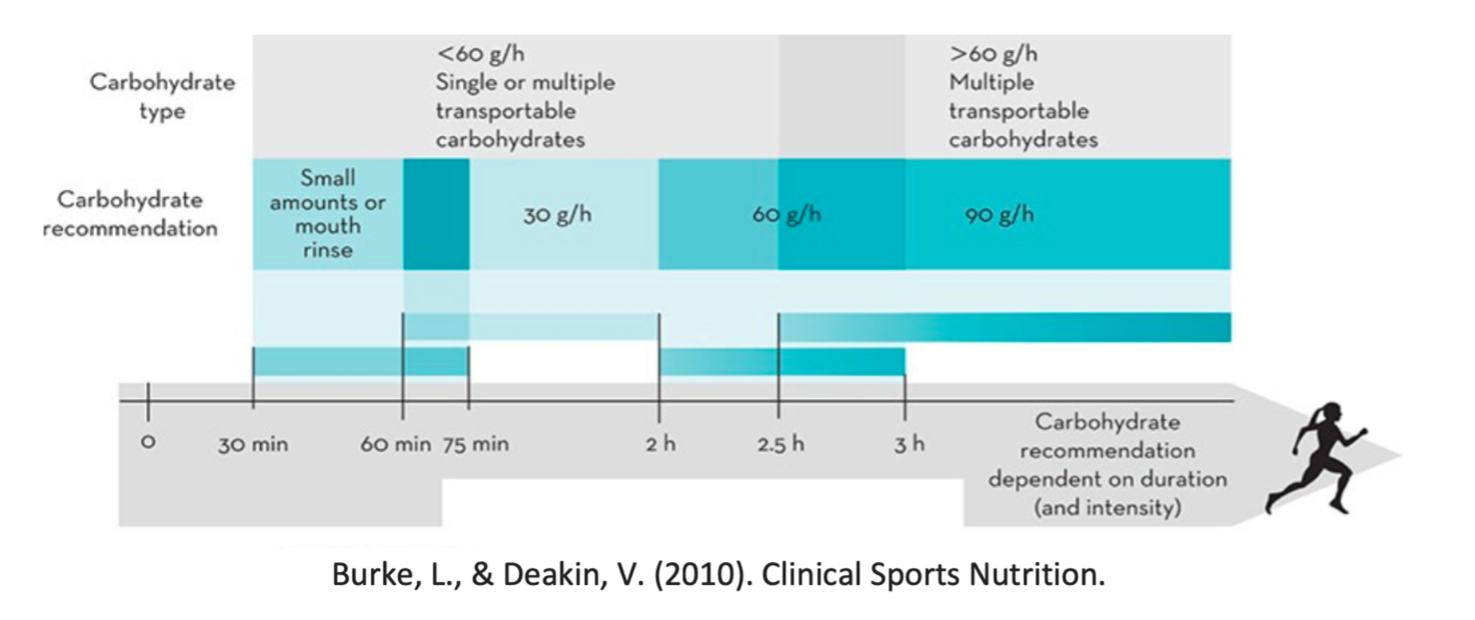
1–2.5 hours: 30–60 g carbs/hour
> 2.5 hours (or very hard / race simulation): ~90 g carbs/hour
The most effective approach is to use a glucose + fructose mix (multiple transporter), ideally around a 1 : 0.8 ratio, which improves carbohydrate oxidation and reduces GI issues vs glucose-only or older ratios. If we need to consume larger amounts for long duration or high intensity events, training the gut to tolerate the intake is important. If you’re not currently tolerating higher intakes, increase this gradually over a number weeks.
Here is a nice infographic to guide carbohydrate intake during training.
Post Training/Racing (0–30 minutes)
If the session was intensive or long duration (VO₂max / anaerobic / race simulation / long ride) and you will be training the next day or in a short period of time, then what you eat close to the finish of that session will play an important role on how you perform in the next. Replenish of liver and muscle glycogen will play a big role in this. Liver gycogen can be replenished pretty fast (~12h) however muscle glycogen can take 24-36h so it is important that this starts early.
Aim for 0.8–1.2 g/kg/hour for the first 4 hours post-session (highest priority if you train again soon).
Protein: 20–30 g high-quality protein alongside carbs. This will not only help repair but enhance glycogen replenishment.
Increase fluid intake until you’re back near pre-session body weight and urine is a light straw colour.
If the session was easy (endurance / recovery ride / or no training for a couple of days):
Keep protein consistent, but you usually don’t need to go too carb heavy the same way. Adjust carbohydrate intake according to over all energy requirements for the day.
Hydration: Practical targets (then personalise)
Hydration needs can vary significantly for individual to individual and the current environment training/racing is about to take place in, therefore it is often difficult to prescribe a specific hydration plan. Its suggested that using some general principles to start with and then adjust hydration needs accordingly using feedback of RPE, hydration status measurement (urine colour) and/or calculating sweat rate at a specific environmental temperature.
General drinking guidelines during exercise:
Cold: ~250 ml/hour
Temperate: ~500 ml/hour
Hot: ~750 ml/hour
Then personalise with a simple sweat-rate check:
Sweat rate at particular temperature and intensity ≈ (weight loss (pre-post) + fluid consumed) / hours of exercise
For recovery- aim to drink 0.5 to 0.75 of sweat rate.
*IMPORTANT For longer durations or hot environments be careful not to over consume or force water on its own. Over-drinking without replacing sodium can cause hyponatremia (low blood sodium levels) which can be very dangerous. In these situations, add some electrolytes (not too many) to your drinks if they are not already included.